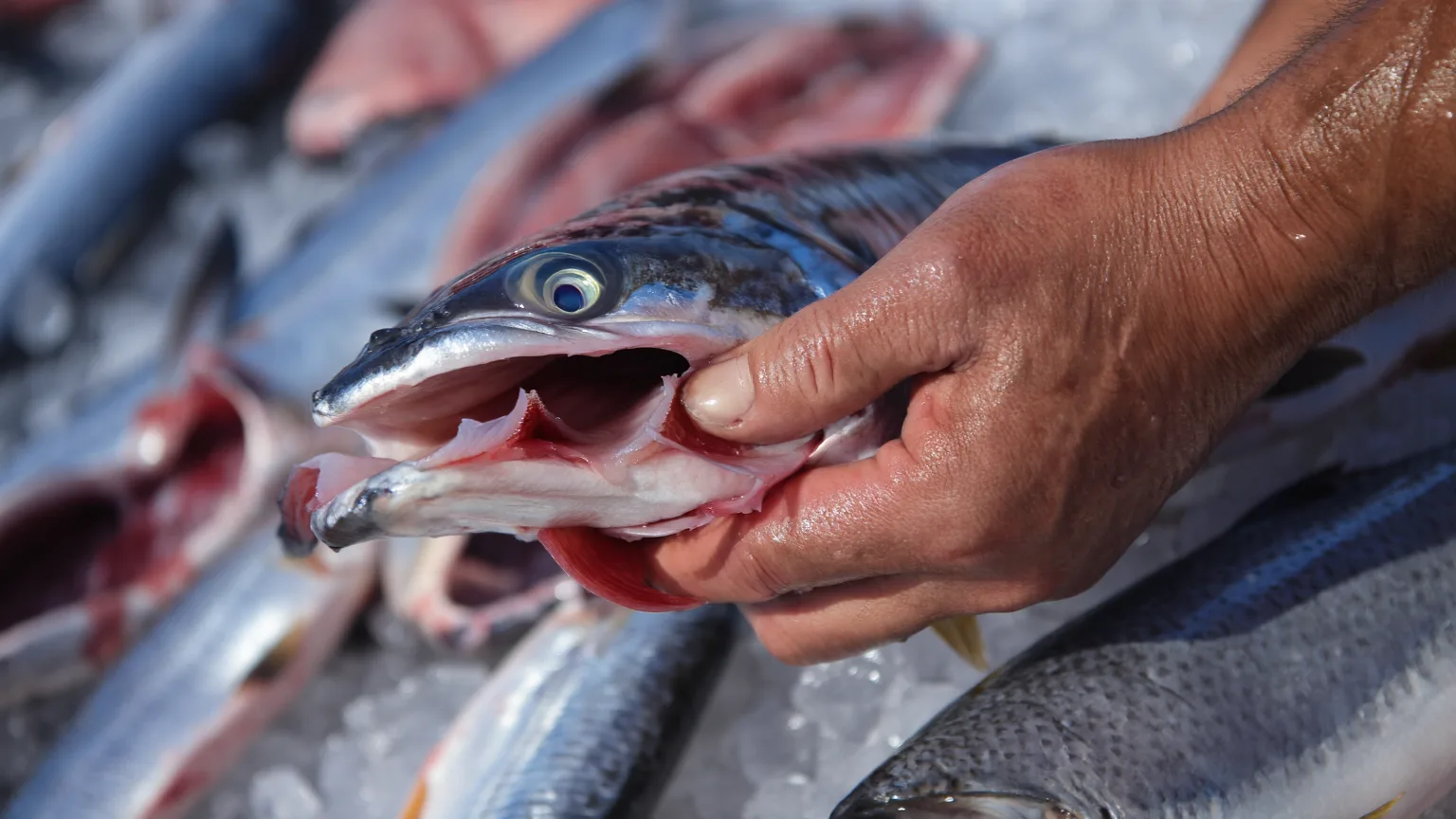
Checking a Whole Fish
Three checks matter most. The eyes should be clear, slightly bulging and bright rather than sunken, cloudy or grey — this is one of the fastest signs a fish is ageing. The gills, lifted gently, should be a deep red or pink, not brown or grey. And the flesh, pressed lightly with a finger, should spring back rather than leaving a dent. A fish that fails any one of these tests may still be safe to eat but will not be at its best.
Smell is the most talked-about test and the least precise on its own. Genuinely fresh fish smells faintly of the sea, clean and mild — not "fishy" in the strong sense most people associate with the word. A sharp, sour or ammonia-like smell is the real warning sign, and by that point the fish is past its best regardless of how it looks.
Checking Shellfish and Crustaceans
For live bivalves, the shell test covered elsewhere in this guide is the one that matters: closed, or closing when tapped, means alive and fine. For prawns and shrimp, look for a shell that sits tight to the body without gaps, and a head that is still firmly attached — a separating head is one of the first signs a prawn is no longer at its peak. Black spots on the shell of a raw prawn indicate the early stages of natural enzymatic breakdown, not contamination, but they are still a useful sign to buy elsewhere if freshness is the priority.
Cooked crustaceans should smell clean and sweet. Any sourness, however faint, is worth trusting over the seller's assurance.
What Ice and Storage Can and Cannot Fix
Good storage slows deterioration but does not reverse it. Fish properly packed in ice, with the ice touching the fish rather than sitting beside it, will hold its quality far longer than fish left at room temperature or loosely refrigerated. But no amount of good storage restores a fish that was already past its best when it was iced. This is why the physical checks above matter more than how a fish has been kept — they tell you the actual state of the flesh, not just how carefully it has been handled since.
Freshness at Home
Once fish or shellfish is home, the same principle applies: cold and quick use are what preserve quality, not the passage of time alone. Fish keeps best stored on ice or in the coldest part of the refrigerator, loosely wrapped rather than sealed airtight, and is generally best cooked within a day of purchase unless it was previously frozen at sea, in which case it can often be safely frozen again briefly at home before quality drops noticeably.
A simple habit worth building is to buy seafood last on a shopping trip and get it into the refrigerator promptly, since even an hour or two at room temperature on a warm day measurably shortens how long fish or shellfish will stay at its best.
For anything not being cooked the same day or the next, freezing is generally a better choice than letting fish sit in the refrigerator for several days hoping to use it in time. A fish frozen while still genuinely fresh and properly wrapped to limit air exposure will usually eat better than the same fish left unfrozen for four or five days.